A week with the families ICE calls "Other Immigration Violators"
.svg)
.png)


This week, I volunteered with an amazing group of attorneys from the Bay Area (shout out to Jacqueline, Misha, Sarah, Cecilia, and Rosanna!) for a week-long trip to volunteer with RAICES in Dilley, Texas, to provide legal services to detained families. As I process everything that happened, I realize there are many aspects of the trip that deserve to be highlighted. But today, I just want to focus on broad strokes – what a day in the life of an attorney volunteer was like. But to understand that day, you have to understand why these families are here at all.
Family detention in the United States has a complicated and contested history. The Obama administration expanded it; advocates fought it in court; the Biden administration closed the South Texas Family Residential Center in Dilley in June 2024, citing cost savings and a shift in enforcement priorities. Then the Trump administration reopened it in March 2025. And as noted in Human Rights First and RAICES’s joint April 2026 report, it is “the sole location for incarcerating immigrant families and children” in the federal system.
To understand why families are sitting in Dilley today, sometimes for months, you have to start with a piece of immigration law that most people outside this practice area have never heard of. In July 2025, the Department of Homeland Security adopted a new reading of section 235(b) of the Immigration and Nationality Act. Then, on September 5, 2025, the Board of Immigration Appeals made that reading binding precedent in Matter of Yajure-Hurtado, 29 I&N Dec. 216 (BIA 2025). The holding is technical, but the consequence is not. The BIA ruled that anyone present in the United States without having been formally inspected and admitted is an “applicant for admission” under section 235(b)(2)(A) regardless of whether they entered the country to seek asylum or how long they have lived here is subject to mandatory detention.
Before Yajure-Hurtado, people could be released on their own recognizance, given electronic monitors by ICE, or ask a judge for a bond under INA § 236(a). After Yajure-Hurtado, the Board held, immigration judges lack authority to hold a bond hearing or release them on bond. Instead, this entire population (some estimates put it close to 10 million individuals) is subject to mandatory detention. While habeas petitions in District Courts have largely been successful, there is currently a Circuit split on the validity of this ruling. But a habeas win is individual and slow, and it requires a lawyer to file it. So even as courts chip away at the ruling, the detention itself grinds on for everyone who hasn’t found one. And unlike in criminal court, there is no public defender in immigration proceedings because while there is a right to seek counsel, there is no court appointed counsel. That means detainees must find and pay for their own lawyers. In a facility this remote, far from any population center able to sustain a pro bono bar, that right is meaningful only in theory – which is exactly why volunteer groups like ours come.
As a result of Yajure-Hurtado, the profile of who ends up in family detention has shifted dramatically. The original political justification for aggressive detention was public safety. Policy and publicity focused on recent border crossers and people with serious criminal histories. But Rep. Joaquin Castro, who has visited Dilley multiple times, said it plainly after one visit: “There isn’t a single criminal in the Dilley detention center. ICE told me that. And yet many of them are languishing there for weeks or months.” The median age of detained children at Dilley is 7 years old. Over half the families interviewed for the Human Rights First/RAICES report were held for more than two months. Some were held for 180 days or more.
Between April 2025 and February 2026, more than 5,600 people… parents, children, toddlers, and newborn babies…passed through Dilley. Core Civic, the private prison company operating the facility, reported $180 million from the Dilley contract alone in 2025 revenue. The Flores Settlement Agreement, which generally limits how long children can be held in immigration detention, sets a roughly 20-day target. But while those are the “rules,” they often aren’t followed. And with all of this happening in rural Texas, far from any population center able to sustain pro bono assistance, it’s tough to enforce those rules.
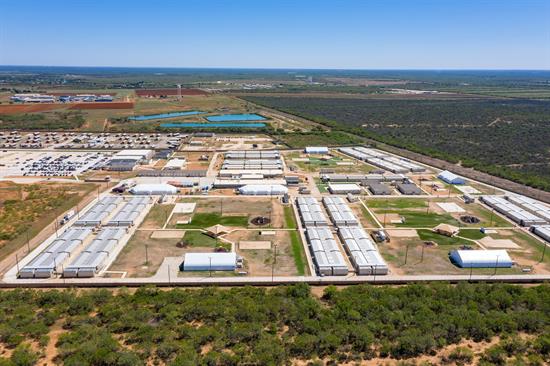
The people Yajure-Hurtado keeps locked up are the people I sat across from this week. Not abstract statistics: specific women, with specific children, in a specific 50-acre facility in South Texas. Here is what it took to reach them.
Every morning we pile into our car with our clear plastic backpacks holding our IDs and bar cards, a sealed plastic bottle of water, and some kind of bar to snack on. On a few of the days, one of the women was allowed to bring a tiny hand sanitizer. On another day, she wasn’t. An extra pair of socks was vetoed. We check in, waiting for them to verify who we are and confirm we have appointments scheduled. After going through security, getting scanned, and being escorted to the trailer that houses the visitation rooms, we get set up. We have to bring a hotspot because there’s no wi-fi access for the public. There are 16 small rooms, each equipped with a computer, a landline, and a table.
We check in with the officers on duty who confirm our appointments and assign us rooms. We don’t get to see any other part of the facility. Then we wait for our clients to be brought in. There’s an initial first group, and usually about four attorneys are quickly matched with names on our volunteer spreadsheet. Then we wait for the stragglers. A few of my clients were no-shows. A few were several hours late. The reasons varied: miscommunications about the appointment time; the facility scheduling a client for something else at the same time; trouble getting through the lunch line; officers called away and unable to escort them right away. It feels like a regular job where you hear about forgotten appointments, traffic, a sick child. But it’s different. They have no autonomy, no freedom, no ability to make the choices that would have brought them in on time.
The place itself tells you everything about that. Dilley’s 50-acre campus has small cottages, a library, playgrounds, a school — and the official descriptions stop there. But the texture of daily life is what you notice when you’re inside it, waiting alongside your clients.
Everything is monitored. Kids can’t take a cookie from the cafeteria to eat later in their room. All food must be consumed on site, at the assigned time, under supervision. Families are assigned clothing. If someone who loves you wants to send a new pair of socks – a grandmother, a cousin, a church group – the answer is no. The facility itself states officially that it cannot accommodate personal letters or greeting cards from friends and family. You can be locked up here with your elementary-aged child and not receive a birthday card.
What I see, sitting in those 16 small rooms, is people in prison. Not a “residential center.” Not a “processing facility.” A place where you wear what you’re told, eat when you’re told, wait as long as you’re told. And worse than a prison sentence with a finite end, these families have no reliable way of knowing when it will end. And yet, against all that waiting, our own work runs on a clock.
While waiting is the name of the game in nearly everything at Dilley, our meetings turn into a rush. As volunteer attorneys, we are here to help people at all levels of the immigration process. Some people recently arrived and are awaiting a credible fear interview. We do a basic intake, provide as much information as possible about the interview, their rights and obligations, how to look for an attorney. All the usual things. But then add on explaining how to access the facility library, how to use the copy machine, gathering information on sponsors, and walking through how someone can put money in their commissary fund. Making sure we get their inmate ID in addition to their A-number.
Sometimes the meetings end in nothing. They’ve had their credible fear interview weeks ago and haven’t gotten a determination. They received a negative decision and are awaiting deportation, maybe a habeas in the meantime. Or they are one of the lucky ones who found an attorney and no longer need pro bono services.
Other times the person is about to have a hearing and we need to fill out an I-589 – no small feat in the 2-to-4-hour time slot you have. Develop enough of a relationship with someone that they’ll tell you about the most traumatic experience of their lives, their deepest fears. Both for themselves, and more heartbreakingly, for their children. And also fill out four pages of biographical information detailing every address they’ve ever lived at, every job they’ve had. On the outside, this process takes months. Attorneys have time to gently walk clients through their experiences, to give them room to break down, to reschedule, to recommend therapists. But that’s not the case here. The best many of them will get is a stranger who walks in and assures them yes, she’s an attorney, and that they have three hours to lay everything out.
With one client, this is exactly what happens. She sits down across from me by herself because she left her two kids with someone she met a few days ago. She doesn’t want them to hear what she has to talk about. She’s still confused about the process. She’s never had a lawyer, never had anyone really listen to her story. The whole story, in order, with room to say “and then,” and “but before that,” and “the reason I couldn’t just….” She has been in this facility for weeks. She has been carrying this story the entire time.
I take notes. I ask questions. I try to understand the geography of a town I’ve never been to, the structure of an organization I can only learn about secondhand, the pattern of threats that finally became unbearable. I write a declaration — a detailed, first-person account in her words — that her immigration judge will read. This is what being heard looks like inside a detention center. It looks like someone leaning forward, filling in detail they didn’t know anyone would want, watching you write it down.
Austin Kocher, a Syracuse professor who tracks ICE detention data on his Substack, has documented that the detained population peaked at over 70,000 people in January 2026 – the highest number ever recorded in ICE’s publicly available data – before declining to around 60,000 by early April. Even that lower number is higher than any detention population recorded before this administration. And the increase in numbers is people swept up through the new interpretation of section 235. Again, a technical reading of a technical status. But what that means, in human terms, is that the expansion of detention in the United States has been built almost entirely on incarcerating people like the women I met at Dilley. Families. People with no criminal record. People who came to this country because something terrible was happening to them and they had run out of other options.
If you want to follow the data on immigration detention, Austin Kocher’s Substack at austinkocher.substack.com is essential reading. His companion site: DetentionReports.com, built with Adam Sawyer, tracks facility-level detention populations in near real time.
If you want to support the legal work happening at Dilley, RAICES can be found at raicestexas.org.
.png)


